I thought I should upload a chapter I wrote with Ben Jones for a conference and publication on how allies of the USA view the US. This is from 2011, and what I've uploaded is one of the final drafts I have saved, so it's NOT for citation. Please email me to check if you'd like to reference it. Some of the ides at the start, particularly on the Lib Dem worldview, are quite hazy. I've been working on them since and further publications are to follow.
The chapter is on my page on academia.edu:
https://www.academia.edu/1513613/The_Liberal_Democrats_and_the_UK-US_Relationship
Friday, April 18, 2014
Monday, April 07, 2014
Evidence to the House of Lords EU Sub-Committee C (External Relations) inquiry into the Transatlantic Trade and Investment Partnership
The written evidence I submitted with Dan Hamilton to the Lords EU Sub-Committee C's inquiry into TTIP can be found on pages 94-100 here.
The committee's full report will be published in due course.
The committee's full report will be published in due course.

Friday, April 04, 2014
Evidence to the House of Commons Foreign Affairs Committee's inquiry into Government Policy Towards the USA
Written evidence I submitted to the Commons FAC's inquiry into UK government policy towards the USA can be found here. I've also pasted the text below. The full report, which includes several references to my evidence, can be found here.
Written evidence from Dr Tim Oliver (USA 13)
Fritz Thyssen TAPIR Post-Doctoral Fellow at the Center for Transatlantic Relations,
Johns Hopkins University School of Advanced International Studies, Washington D.C.
Johns Hopkins University School of Advanced International Studies, Washington D.C.
A UK withdrawal from the EU: implications for the USA and transatlantic relations
Summary
- Britain’s relationship with the EU is often seen as one of the key benefits it can offer in the UK-US relationship. Despite talk of an ‘Asian pivot’, Europe – and increasingly the EU – remains crucial to US economic, security and political interests.
- The UK should never lose sight of the US-EU relationship and what British policy towards the EU could mean for this much larger transatlantic relationship.
- A British withdrawal from the EU could have significant implications for both the USA and the EU. The paper outlines the possible implications for the EU of a UK withdrawal, and what this could then mean for the USA’s relationships with the EU and UK.
- For the USA, a UK withdrawal from the EU could be a lose-lose scenario: reducing the geopolitical position of Britain, one of its closest allies; and changing the EU and Europe in ways which could be detrimental to US interests.
- UK policy towards the EU could also have implications for the wider transatlantic relationship. A breakdown in UK-EU relations could undermine or weaken the Transatlantic Trade and Investment Partnership (TTIP). This would be a loss to the UK’s long-standing policy of encouraging closer geopolitical relations between the two sides of the Atlantic. It would also be a loss to US efforts to engage the EU in a wider geopolitical relationship.
About the author
Tim Oliver is a Transatlantic Post-Doctoral Fellow for International Relations and Security (TAPIR). From 2012-2014 the fellowship will see him based at the Stiftung Wissenschaft und Politik (Berlin), the Center for Transatlantic Relations, Johns Hopkins University’s School of Advanced International Studies (Washington D.C.), and the RAND Corporation (Washington D.C.). His fellowship is funded by the Fritz Thyssen Stiftung. He was educated at the University of Liverpool and later received his MSc and PhD from the London School of Economics. His PhD in international relations was taken under the supervision of Professor William Wallace (Lord Wallace of Saltaire). He has taught at the LSE, UCL and prior to his current fellowship spent several years as a Senior Lecturer in the Department of Defence and International Affairs at the Royal Military Academy Sandhurst. Before Sandhurst he spent several years working in the Liberal Democrat Whips’ Office of the House of Lords. He has also worked in the European Parliament, Brussels. His current research includes a focus on the implications for the EU and USA of a UK withdrawal from the EU. The opinions expressed in this evidence are his own and should not be taken as reflecting those of the SAIS Center for Transatlantic Relations or the Fritz Thyssen Stiftung.
Implications for the EU of a UK withdrawal
- The House of Commons vote rejecting UK involvement in military action in Syria raised a range of concerns in the USA about British isolationism and retreat. Many of these concerns were wide of the mark. The UK-US relationship has endured many periods of crisis, some far more serious than the Syria vote. A vote to leave the EU would not cause an immediate crisis in relations with the USA. But it would change the nature of the UK-US relationship in the longer term.
- Focusing on the implications for UK-US relations reveals only part of the problem for the USA. A British withdrawal would also change the EU, meaning the USA would have to adapt its relationship with Brussels and the other member states.Therefore to understand the implications for the USA of a British withdrawal, we need to examine how the EU could be changed, and what this could mean for the USA and transatlantic relations.
- While there is a considerable amount of literature examining the implications for the UK of a withdrawal from the EU, the implications for the EU is a very under researched topic. The following analysis is drawn from research I undertook while writing the study ‘Europe Without Britain: Assessing the impact on the EU of a British withdrawal’, published in September 2013 by the German Institute for International and Security Affairs (SWP).[1]
- A UK withdrawal would have three sets of inter-connected implications for the EU:
- First, the EU would have to spend time negotiating a withdrawal with the UK. The timeframe set out in Article 50 – the untested withdrawal clause of the EU’s treaties – is two years, possibly longer if both sides deem it necessary. There is a good chance the withdrawal negotiations will follow failed/rejected negotiations for an alternative relationship for the UK within the EU. These negotiations could have taken between 1-2 years. When added to wider changes in the EU – in particular a possible treaty change to deal with the Eurozone’s problems – the context within which a UK withdrawal could take place would be one of considerable institutional flux and naval-gazing by the EU.
- Second, the EU’s institutions, voting systems, budgets and policies will need to change in order to fill the gap left by the UK. When these are combined with changes to the Eurozone, a British withdrawal could add to shifts in the EU’s balance of power. Numerous under-researched scenarios exist as to how the EU might change.
- The most common concern found elsewhere in the EU – and in the USA – about a UK withdrawal is that it could make the EU more inward looking, pushing the EU towards protectionism and away from a more liberal economic order. It could also make the EU more inward looking on security issues. The union would look more towards the Mediterranean instead of the Atlantic. Smaller states could gain over large states. The Franco-German axis could be unsettled, leaving an even more dominant Germany. EU enlargement to states such as Turkey or Ukraine, something already suffering from ‘enlargement fatigue’, could grind to a halt in the face of unease amongst northern and western states at the EU’s centre shifting further south or eastwards. The implications for the Irish Republic would also have to be taken into account.
- On the other hand, rid of what many in the EU consider a notoriously ‘awkward partner’ the Eurozone could become the undisputed core of the EU, pushing the EU further towards ‘ever closer union’. Future problems facing the Eurozone could be more easily and directly dealt with. Europe’s social model could be freed of British attempts to weaken it. EU efforts at foreign, security and defence cooperation would lose an important partner. But while the UK is central to such efforts, it has also been central to limiting them. Its removal could act as a spur to EU action in these areas, especially if further political union emerged following the Eurozone crisis. The extent to which Britain slows the EU has been put into perspective by the Eurozone’s own struggles to find solidarity and leadership. Nevertheless, with the UK removed from the formal decision making process the EU would be free to develop in ways the UK would be unable to vote against or veto.
- The third set of implications relate to the EU’s external relations: with the rest of non-EU Europe; with the wider world, including the USA; and the EU-UK relationship.
- The wider political and economic framework of relations in Europe could be changed, with implications for the EU’s relations with states such as Norway and Switzerland. If the UK and other non-EU members thrived and the Eurozone continued to struggle, then Britain’s withdrawal could trigger centrifugal forces that lead other member states to question their membership, in turn unravelling the EU. However, this ‘domino theory’ has to be set against the likelihood of another domino effect within the EU should the UK secure a renegotiated relationship granting it special privileges. Other states could then demand concessions, creating a much feared ‘pick and mix’ approach to EU membership. At the same time, if the UK struggles outside the EU then the UK’s appeal would be limited, strengthening the EU’s position. A background concern here is the problems the EU’s enlargement policy has faced with states in central and Eastern Europe. If the UK’s decision appealed to far-right or far-left political parties in these states, then it could add to the problems faced in anchoring these states into a European mainstream.
- The UK and EU will need to think about how the rest of the world might interpret a British withdrawal. Could it be taken as another sign of European division, disunity and weakness? It will mean there will still be no clear answer to “who speaks for Europe?” if the UK and other non-EU European states disagree with the EU. Europe could become more vulnerable to divide and rule by external powers, for example how might Russia interpret the move with regard to its approach to states in Eastern Europe? Would France come under more focused pressure to cede/share its permanent UNSC seat with the EU? Implications for the USA are discussed below.
- Finally, Article 50 requires the EU to attempt to negotiate a post-withdrawal relationship with the withdrawing member. Unless some form of relationship were agreed allowing the UK a direct say in internal EU business (something the EU has strongly resisted with all other non-EU European states), then the UK would move from decision maker to a decision taker and decision shaper. Should the EU remain the predominant political and economic organisation in Europe, then the UK will need to pursue close relations with it. The UK is therefore highly likely to put great effort into shaping the EU’s policy agenda, both through lobbying efforts in Brussels, and through efforts directed at individual member states. While we should not overplay the UK’s potential to sow divide and rule to secure its ends, we should also not overestimate the EU’s ability to present a united front to the UK. The EU has struggled to present such a position in relations with the USA, Israel, Russia and others. With the UK, the EU would face a state containing a government, business community and civil society who would have over forty years of experience of EU politics, and a bigger interest in the EU than any other non-EU state.
Implications for US-European relations
- The USA could face a lose-lose scenario from a British withdrawal from the EU. First, as discussed further below, from the perspective of the USA and other powers, the UK’s geopolitical significance would be significantly reduced. Second, the USA would also face an EU changed by the UK’s withdrawal, and changed in a way potentially detrimental to US interests.
- There would no shortage of applicants to fill the position of claiming to be the USA’s closest ally within the EU. While such applicants might struggle to offer a relationship that could claim to be as ‘special’ as that with the UK, for the USA they will be of increased importance thanks to Europe, and the EU, being an area of the world in which it will retain considerable interests. As President Obama made clear in his state visit to the UK in 2011, Europe remains the cornerstone for US global engagement and the greatest catalyst for global action in the world today. Should the UK absent itself from the predominant political and economic organisation in Europe, then it would be disengaging from a partner the USA increasingly looks towards working with.
- The extra effort the US would put into these other relationships inside the EU, would in part stem from a desire to ensure the EU does not change to the detriment of US interests. This is not to argue the EU with the UK inside has always been congenial to US interests. Nor is it to argue that the UK is the only way the US can exert influence (the ‘American Trojan Horse’ theory). Nor is it to argue the EU must always align itself with US interests. But a British withdrawal could add to existing US worries about the EU’s development and capabilities, and how they will impact on the USA and the wider security environment in Europe and its near abroad.
- A British withdrawal could add to US concerns that Europe lacks the political energy to think about the geostrategic implications of the rise of powers such as China and Brazil. These concerns have been fuelled in recent years by the EU’s focus on its internal problems such as the Eurozone crisis, or before this over the failure to adopt the EU constitution. The USA would not want to see further ‘naval-gazing’ brought on by a British withdrawal.
- A British withdrawal could also add to a fear Europe will continue to free-ride on a US security guarantee, one primarily provided through NATO. The USA has shown clear frustration at Europe’s inability to deal with security issues in its near-abroad, for example in the Middle East and North Africa. Changes to the configuration of US defence capabilities mean the USA is likely to continue to try and shift some of the burden of dealing with issues in these areas towards Europe.
- It would be wrong to assume a UK withdrawal from the EU would have no impact on NATO or not weaken it in anyway. The disappearance from the EU of one of its major military powers could further strain efforts at Europe-wide defence cooperation, whether through the EU or NATO. Nobody should cheer the failure of the EU, Europe’s dominant economic and political organisation, to facilitate improved cooperation on defence spending and business. If the EU continues to struggle in this, then Washington may well wonder what hope remains for Europe ever organising itself better on defence – whether through NATO or the EU. If, however, a UK withdrawal opened the way for the EU to organise better on defence, then the USA’s key military ally in the EU will have absented itself from this, necessitating stronger links between the USA and the developing EU defence capability.
- For the foreseeable future the US will continue to work through NATO or through coalitions of the willing on key issues. But in the longer-term, the United States will likely need a stronger and more coherent European Union to advance commoninterests in the face of emerging powers. If the Transatlantic Trade and Investment Partnership were successfully negotiated then the centre of gravity in transatlantic relations could shift further from NATO towards the US-EU relationship. From Washington’s perspective, having a pro-American UK in the EU enhances the prospects of the EU being a reliable American partner with whom it can defend and advance common interests.
Implications for the Transatlantic Trade and Investment Partnership
- TTIP has emerged as an important development for all sides in the Atlantic relationship. For the current British government TTIP offers numerous opportunities: it offers the chance to show the EU works for the UK by helping to secure the largest bilateral trade deal in history; it could advance the UK’s long-standing aim of binding the two sides of the Atlantic closer together; it could provide for all sides a much-needed geopolitical framework through which the two core parts of the West can approach the opportunities and challenges of emerging powers; and it could provide much needed export led growth for the UK. The UK plays a central part in TTIP, both economically and geopolitically. However, Britain’s relationship with the EU presents a series of problems for TTIP’s negotiation and operation.
- There is a risk TTIP could become caught up in the UK's attempts to renegotiate its relationship within the EU. The idea the UK could quit the EU is currently a background concern for TTIP, but it is not one that has passed unnoticed. TTIP negotiations aim to conclude by the end of 2014, but they have already run into problems. Negotiations could be delayed further by the 2014 European Parliament elections possibly seeing the election of a parliament more critical of the EU and of TTIP. It alsoremains to be seen whether bipartisan support can be maintained in the US Congress. In the UK context the possibility of an in-out EU referendum before the widely expected date of 2016/17 (to say nothing of implications from the September 2014 Scottish independence referendum) cannot be ruled out, especially if the 2014 European Parliament elections produce a landslide result for UKIP. If TTIP negotiations were delayed into 2015 then there is the possibility they could become caught up in a British General Election, also occasionally suggested as an earlier date for an in/out referendum. Any delay beyond the middle of 2015 could find TTIP negotiations taking place at the same time as the UK and EU begin attempts at a renegotiated relationship. While a TTIP without the UK would not be impossible – indeed, the USA and EU have warned this could happen – it would be more difficult and a lesser deal if secured. It might also be a more difficult sell to the USCongress.
- At the same time, a collapse or significant delay of TTIP negotiations caused by one or more of Britain's EU partners, would fuel calls for the UK to quit the EU. Eurosceptics have long argued the EU holds Britain back from negotiating its own trade deal with the USA. But there's a twist. TTIP is predicted to weaken Britain's economic relationship with Europe in favour of its already strong transatlantic economic relations. While other EU states would also experience this, their political commitment to some form of political union is not reflected in the UK where, at least in public debate, the economic dimension has always come first. For British Eurosceptics a weakened UK-EU economic relationship would help ease the way for a UK exit.
- No doubt a UK outside the EU could secure some form of partnership within TTIP, but what this partnership would be is not clear. Canada’s position could offer one model, but what this might be remains unclear. Nor is it clear the EU would allow the UK anything less than a backseat in TTIP: TTIP will clearly rest on a Washington-Brussels axis.
- Any discussion of the UK joining NAFTA, or seeing TTIP as a purely trade and investment deal, overlooks the USA’s desire for a wider geopolitical relationship with Europe, and in particular here, the EU. This returns us to US concerns the EU is found to be lacking when it comes to geostrategic thinking. A UK withdrawal that weakens EU efforts to think in a more geostrategic way, or which complicate or undermine TTIP, would only dampen what hopes Washington still has that Europeans – Britain included – can act as effective partners. Any weakening of the links between the two sides of the Atlantic – the core of UK foreign policy – would also be a spectacular home-goal by the UK.
Implications for UK-US relations
- The vote on Syria raised once again the debate about Britain’s place in the world, its relations with the USA, and whether it can sustain its ambitions to be a global player. But the debate about Britain’s place in the world – including its relationship with the USA – is shaped more than anything else by discussion about Britain’s place in Europe. This is a debate so persistent and divisive because it goes to the heart of British identity, security and political economy. It is on the issue of Europe that rests so much of the question of what country the UK wants to be.
- For the USA, a decision by the British to answer this question by quitting the EU will leave Washington facing an ally still facing painful dilemmas about its role in the world. Some talk of a vote to quit the EU as the means to assert Britain’s independence as a ‘Switzerland with nukes.’ That those nukes would be carried on US built and serviced missiles shows the limits of that independence. That Switzerland is more bound to the EU than some in the UK like to think, shows the limited thinking about what being ‘out’ of the EU would mean.
- More importantly, Britain would still struggle to assert its sovereignty in the face of a Europe where the EU is likely to remain the predominant political actor, and a more important actor in the daily lives of the British than any other state or international organisation, including the USA.
- For the USA, a British withdrawal would lead it to reassess the relative merits to be given to its bilateral relationship with the UK, compared to its much larger multilateral relationship with the EU and its member states. Few in the American foreign policy community would subscribe to the idea the US-UK relationship would be strengthened if the UK were to leave the EU.
- This does not mean that outside the EU the UK will not remain an important ally of the USA. Economic links will continue to develop, but in the shadow of TTIP or some other US-EU economic relationship. The practical core of any ‘special relationship’ will more than likely remain in nuclear weapons, intelligence sharing and special-forces. British prime ministers will continue the long-standing approach of offering British military contributions to US military operations as a way of securing influence in Washington, in turn securing a continued US defence commitment to the UK. But the UK could find this increasingly difficult in the face of sustained defence cuts. Other options will need to be considered that rely less heavily on a military contribution.
- It is often overlooked elsewhere in Europe, but also to some extent in the UK, that one of the UK’s aims in pursuing close relations with the USA has been to maintain the USA’s commitment both to Britain and to Europe. Europe and its near-abroad will remain the core of UK security concerns. The UK should not fall into the trap of assuming the USA’s ‘pivot to Asia’ means Europe will no longer matter to the USA, or that the UK can mirror such disinterest. This overlooks the continued interests the USA has in Europe, Washington’s desire to rejuvenate the transatlantic relationship, and its efforts to encourage Europeans to shoulder more of the security responsibilities in Europe’s near-abroad.
The UK must avoid a situation in which a US Administration is forced to choose between a deep and special bilateral relationship with the UK, and a more brittle, but much larger and important relationship with the rest of the EU. From the perspective of Washington the UK and EU are increasingly bound together and should remain so for the health and relevance of the transatlantic relationship. Nor will the USA appreciate being drawn in to play the part of some form of common friend acting as a councillor trying to limit the damage, not least to its own relations with its European allies, from a UK-EU divorce.
October 2013
Monday, March 17, 2014
Londoners are not little Englanders
A post for the LSE's British Politics Blog.
Euroscepticism is far stronger in other areas of the UK, especially in areas of England, than it is in London. London’s economy, population and politics offer immediate reasons for this more comfortable view of the EU. The views held by Londoners of the EU should remind us that labelling the UK, or England, as ‘Eurosceptic’ overlooks how views of the EU vary across them both, writes Tim Oliver.
Londoners view the EU more positively than most other people in the UK. Despite this ‘London’ often becomes short-hand for a veto wielding UK government, Eurosceptic backbenchers, English Euroscepticism or more broadly a Britain that can be an awkward partner for the rest of the EU. To some extent this is understandable given London’s dominant position in the UK. However, we should be careful not to overlook the opinions of the more than 8.5 million people that make up the UK’s biggest city and region, the home of Britain’s most diverse and international population, the heart of the British economy, the centre of UK politics and culture, and the EU’s biggest city.
UKIP has generally performed below average in votes to elect London’s MEPs. In the 2009 European Parliament elections UKIP in London received its second lowest share (10.8%) of the vote of any region in Great Britain, its lowest being in Scotland (5.2%). In the forthcoming European Parliament elections UKIP’s share of London’s vote looks set to go up, but this looks likely to happen across Great Britain including in Scotland.
If Londoners remain consistent with polling data then UKIP’s share of London’s vote will remain below their national average. This should not be a surprise. The British Election Study Continuous Monitoring Survey shows 58.6% of Londoners overall approve of Britain’s membership of the EU. London is just beaten into second place by Scotland where 59.1% overall approve, although London is home to the largest group who ‘strongly approve’ of EU membership. These compare to a UK average of 49.2% overall approving of EU membership, and 46.4% when calculated for areas of England outside London. With 41.4% of Londoners overall disapproving there can be no denying that Londoners still show a strong degree of Euroscepticism, but Euroscepticism is much stronger in other areas of the UK, and especially other areas of England. On views of the EU Londoners are closer to the Scots.
Table 1: “Overall, do you strongly approve, approve, disapprove, or strongly disapprove of Britain’s membership in the European Union?”
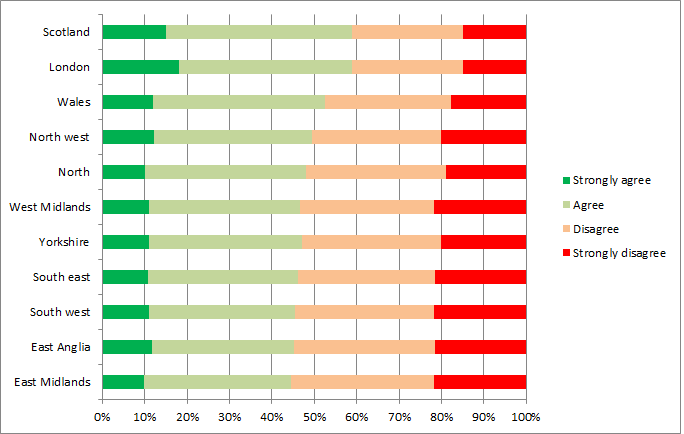
Note: The data were provided by Dr Ben Clements and come from the British Election Study Continuous Monitoring Survey (BES CMS), based on the pooled June 2005-December 2012 monthly cross-sectional surveys (weighted data). The BES CMS dataset was obtained from the main BES 2009/10 project website.
London’s European World
London’s economy, population and politics offer immediate reasons for this more comfortable view of the EU. London has long been one of Europe’s leading centres for trade and commerce. Today, a large part of the material wealth of London is tied to the economic vibrancy of the wider European market as part of a wider global market. Britain might not be in the Euro, but that does not stop London handling more euro foreign-exchanges than the Eurozone combined. Nor does it stop London being the headquarters of one hundred of Europe’s top 500 companies. Companies such as Goldman Sachs and the Lord Mayor of London have warned of the cost to London and the UK of an exit from the EU.
Nor is this a new development. London has long faced large numbers of people arriving from overseas. The arrival of new immigrants that has helped drive Euroscepticism elsewhere in the UK is not unusual for London. As home to the UK’s largest ethnic minority communities, Londoners have long grappled with the politics of immigration and racial politics. This is not to argue it has passed unnoticed. But issues such as London’s insanely high house and rental prices and growing inequality are just as likely to be blamed on the arrival of – and London’s attempts to attract – wealthy Russians or citizens from Middle Eastern states as on immigrants from Eastern Europe.The economic links also reflect a population of which 36.7% (according to the 2011 census) come from outside the UK. About 10.3% come from elsewhere in the EU, a figure that excludes the large numbers of short-term visitors who visit to work or study for several months. Such is the appeal of London, especially to young Europeans, that in 2007 and 2012candidates for the French presidency campaigned in London in order to reach the large number of French voters there.
This heterogeneous population gives London a unique identity politics. Contrary to what some may think, the 2011 census showed that more Londoners identify themselves as British than in any other region of Great Britain. This should come as no surprise given London is the home of the British monarchy, government and other institutions such as the British Museum and the BBC. Black and ethnic minority groups are also more likely to identify with being British than English, and they constitute a large proportion of London’s population. This stronger attachment to British identity matters because as anIPPR report into English identity found, there is clear evidence that people who identify themselves as British tend to be less Eurosceptic than those who identify themselves as English.
London’s own numerous political institutions – its mayor, Greater London Assembly, the ‘City of London’ and its Lord Mayor, along with its intimate connections with British government in Whitehall and Westminster – provides it with more political autonomy and representation, in both the UK and the EU, than any other area of England. The EU does not appear as remote and uncontrollable as it might in other areas of the UK. There could be no clearer example than David Cameron wielding a UK veto to defend the financial interests of institutions based largely in London. This is not to deny the EU can challenge London, especially on the financial workings of the City of London. If this were to grow then Londoners support for the EU could take a big hit.
London’s own political institutions also leave it more comfortable with the current constitutional status quo of the UK. As the IPPR noted, the link between Englishness and Euroscepticism is important because, “the stronger a person’s sense of English identity, the more likely they were to be dissatisfied with the place of England within the post-devolution United Kingdom.” This is not to argue Londoners are entirely happy. But a combination of unease about England’s place in the UK and membership of the EU is not something Londoners appear to feel as powerfully. People elsewhere in England are not only increasingly sceptical of the EU, but also of a UK which is perceived to be biased towards areas such as Scotland and London.
Finally, London’s internationalism defines it, perhaps even more so than Europe. London’s economy, its population (a larger proportion of Londoners come from Asia than the rest of the EU), its identity, and its politics are all shaped by its global outlook. As a world city it measures itself not simply by its place in the UK or the EU, but against cities such as New York, Tokyo or Dubai. Britain may no longer be the centre of a global empire, but London still sees itself – with some justification – as one of the centres of world business, culture and politics.
London and an in-out referendum
Given Londoners views of the EU they are unsurprisingly amongst the least likely to support a UK withdrawal from the EU. London will play a crucial part in any renegotiation and referendum campaign. If David Cameron were to get his way – admittedly a big ‘if’ – and seek a renegotiation after the 2015 general election, then most predictions put a referendum in 2017. This means the issue could play into the 2016 election for the London Assembly and mayor. London’s leading business figures, along with the UK media and political elite based in London, will also play a central role in any referendum debate.
London will also shape developments after a referendum, especially if the rest of England were to vote for withdrawal leaving London on the losing side. The possibility of Scotland finding itself on the losing side has prompted warnings that “If the UK leaves the EU, Scotland leaves the UK.” A large number of Londoners and their business and political leaders would likely feel equally aggrieved at being torn from the EU against their wishes. It would counter some claims Scotland was being unfairly treated. Nevertheless, as in Scotland, it would fuel a sense of grievance that the rest of the UK holds London back.Existing demands that London be granted greater autonomy could rise up the agenda. It would create a situation where London finds itself as the multicultural globalised capital city of a fragmenting multinational UK and a Eurosceptic England.
The Many European Faces of London and the UK
The views held by Londoners of the EU should remind us that labelling the UK, or England, as ‘Eurosceptic’ overlooks how views of the EU vary across them both. Clearly the UK is home to some of thestrongest Eurosceptic opinions in the EU. But when understanding any political belief, movement or idea, it is important to note that this is not a single, coherent attitude. Similarly it is important to examine more closely if people are sceptical or supportive of political union or economic and trading links. Understanding attitudes to the EU therefore requires a more nuanced view than blanket UK or England-wide views. Given the structure of the UK it is also easy to create a false dichotomy of a Eurosceptic-English-black to a pro-European-Scottish-white. Not only does this overlook variation within England, but also overlooks the Euroscepticism found across the UK.
London itself is home to a range of views on the EU. Given the strength of Eurosceptic opinion in the South East and East of England, the regions that surround London, it might be that Euroscepticism increases with distance from the centre of London. Generally, however, opinion in London is noticeably different to the rest of the UK and especially England, in that it is less Eurosceptic. No single factor explains this. It is down to a combination of factors such as London’s large EU and foreign-born population, a more British and less English identity, its strong economic connections with the EU, an international outlook, and the ability of London’s political actors to influence the EU through the British government or on its own.
Saturday, March 01, 2014
The dangers of a passive expulsion of Britain from the EU
Published on E!Sharp, 1 March 2014.
Like other leaders and governments across the EU, Angela Merkel has made it clear she does not want to see a Brexit. But there are limits to what she and others will do to prevent this. Antagonism and isolationist thinking by Britain could lead – and in some cases already has led – to some in the EU reciprocating with cold indifference, further weakening relations.
Some in the EU may find this approach attractive. Just as confrontation with an unwanted and unhappy guest can be avoided by making them feel so uncomfortable that they leave of their own accord, so too might the rest of the EU feel it would be easier to make things so uncomfortable that Britain leaves of its own accord.
It’s easy to see the appeal given the alternative is either a direct confrontation to push the UK out, or an attempt at a new effort to keep the UK inside, possibly with a special deal that risks making others feel unhappy.
Responsibility would of course lie in large part with the UK. Britain has been repeatedly warned that such an approach could lead to exasperation by the rest of the EU. Despite this, Britain has failed to sell itself as a good European, one worthy of efforts by the rest of the EU to keep it inside. Its recent record of vetoes, lecturing from the side-lines, growing sense of non-engagement, refusal to participate in efforts to save the Euro, while also expecting to be given special concessions, all add to long-standing complaints that Britain, as the title of the classic book on UK-EU relations by Stephen George put it, is ‘an awkward partner.’
But we should not overlook the behaviour by the rest of the EU. A relationship, as any couple knows, is a two way thing. Is the other half of this relationship letting the other go, and perhaps through a refusal to act, passively getting rid of the UK?
It’s likely that a combination of the EU’s indifference, a need to focus on more pressing matters, weariness at British complaints, and changes to the EU’s structures are leading the EU, willing or not, towards a position where it might be able to passively rid itself of the UK.
It may be that the rest of the EU is simply too busy to notice that the UK is headed towards the exit. Back in 1975, when the UK held an in-out referendum, an EU of only nine member states meant other European politicians were more easily aware of UK concerns. In today’s EU of 28 members, the UK’s voice is more easily drowned out.
Changes to the EU, especially those connected to the UK’s absence from the Eurozone’s institutions and meetings, mean the rest of the EU may be growing into a setup where the UK’s absence is taken for granted. Refusing to consider Britons for top positions, especially those connected to the Eurozone, might seem practical. But it risks worsening Britain’s isolation.
This setup may appeal to those in the EU who want Britain out of the EU. But a passive expulsion would be a difficult strategy, bringing with it a series of dangers for both Britain and Europe. ...
Saturday, February 22, 2014
Book review of Command and Control by Eric Schlosser.
The following review appears in the new issue of International Affairs
Command and control. By Eric Schlosser. London: Allen Lane.
2013. 656pp. Index.
£25.00. isbn 978 1 84614 148 5. Available as e-book.
 As our most dangerous creation, nuclear weapons should never
be out of our minds. But since the end of the Cold War some—at least in the
West—have viewed them as somewhat passé.
Yet thousands of these machines remain ready to inflict incredible destruction.
The possibility of nuclear war or accidents remains appallingly high, and the
link between the two is clearer than ever. With the Cold War passing into
history, we can now better appreciate how close humanity came to oblivion
because of accidents, misunderstandings and failings in command and control
systems. Eric Schlosser has taken this history and brilliantly synthesized it
with science, theory, politics, interviews with and insights into the people
involved. He shows not only how often we came close to nuclear holocaust, but how
this nightmare continues.
Schlosser packs a lot into the book. Foremost is an accident
in 1980 at a missile silo near Damascus, Arkansas. Told in a way that rivals
any airport thriller, the story brings out the consequences that spiral from a
dropped socket puncturing the fuel tank of a Titan II missile with a 9-megaton
warhead atop it. Events in Damascus structure the book, with chapters on the
Cold War and the situation in the silo developing side by side. As the world
approached the climax of the 1980s nuclear arms race, the Damascus missile
exploded, killing one man and throwing the warhead several hundred feet from
the silo.
Along the way you lose count of the incidents and accidents
detailed. The book notes that one US study found that between 1950 and 1968 at
least 1,200 nuclear weapons were involved in significant accidents. What shocks
is not so much incidents of lost nuclear weapons; or security breaches; or the
failure of numerous safety features apart from the most basic switches; or
failures of early warning systems; or how nuclear weapons were accidently
launched, dropped, smashed, crushed in lifts; or numerous plane crashes where nuclear
weapons were subjected to intense fires; or failures in safety systems designed
to cope with accidents. What is most shocking is how many of these were hidden
from those responsible for the safety of the system. And concerns remain today,
for example with regard to the safety of the location of warheads on Trident missiles,
including those used by Britain.
Concentrating on individual incidents overlooks the
purpose—and title—of the book: the struggle to build and manage a command and
control system to manage securely nuclear weapons in war and peace. Those with
knowledge of nuclear weapons will find here familiar debates about theories of
nuclear war; of struggles to manage the breath-taking insanity of SIOP (the
Single Integrated Operational Plan); the always/never dilemma; of how decisions
over nuclear weapons have too often been less about safety and reliability than
about reputations. References, notes on sources and bibliography stretch over
an impressive 122 pages.
The civil−military and interpersonal tensions bring out Schlosser’s journalist skills. He gives some excellent pen-portraits of the men involved. He gives special attention to the men on the ground, the impact on them and their families, and the paltry recognition they receive. This is not just a journalist’s desire for ‘human interest’; understanding these men is essential when coming to terms with why mistakes happen and how the system responds to their individual behaviour. Schlosser has a love−hate relationship with high-ranking men such as Curtis LeMay or Robert McNamara. While he respects their determination to bring strict order and control to nuclear weapon systems, he is never blind to the darker side of what they set out to build and control.
Schlosser’s aim is not policy recommendations, or comparing
the United States with other countries. By the time the book turns to other
states you are left in little doubt that if the US record is a guide, then an
even more terrifying book is yet to be written about what has—and is—happening
elsewhere. Schlosser’s aim is more about challenging the unacceptable and
frightening negligence that has surrounded the issue in the United States.
Inspired by the work of Charles Perrow’s Normal accidents (Basic, 1984)—arguing
that accidents are normal in complex systems—Schlosser writes that the way
forward is to keep the danger clearly in mind and under scrutiny. Tucked away
on page 499, in the final sentences of the ‘notes on sources’, Schlosser sets
out his hope: ‘The suppression of the truth has allowed a small and elite group
of policy makers to wield tremendous, largely unchecked power. There are few
issues more important than what nuclear weapons can do, where they are aimed,
why they might be used, and who has the ability to order their use. I hope my
book contributes, in some small way, to restoring a semblance of democracy to the
command and control of the deadliest, most dangerous machines that mankind has
ever invented.’ Amen to that.
Tim Oliver, Johns Hopkins University, USA
EXTRA, added 1 September 2014. If you want a brilliant take on this issue, one which draws on Schlosser's work, then check out this piece by John Oliver from Last Week Tonight: https://www.youtube.com/watch?v=1Y1ya-yF35g&feature=youtu.be
EXTRA, added 1 September 2014. If you want a brilliant take on this issue, one which draws on Schlosser's work, then check out this piece by John Oliver from Last Week Tonight: https://www.youtube.com/watch?v=1Y1ya-yF35g&feature=youtu.be
Wednesday, February 05, 2014
What if... Britain had voted to leave the EEC in 1975?
Awkwardly Ever After
Published on the DGAP's IP Journal
In our eighth contribution in the PISM/DGAP counterfactuals series, SAIS's Tim Oliver examines what the UK and EU might look like today if the UK’s referendum on Europe had failed nearly 40 years ago.
On June 5, 1975 a Labour government put a choice to the British people: they could either leave the European Economic Community or, as Prime Minister Harold Wilson urged them to do, vote to stay on the new terms his government had negotiated. A 67 percent vote in favor, with a turnout of 65 percent, seemed a solid commitment. European integration has nevertheless remained one of the most divisive issues in British politics, splitting parties and helping topple prime ministers. Relations between the UK and the rest of Europe have been difficult too, typified by opt-outs and vetoes.
It is therefore easy to surmise that both British politics and European integration would have been better off had the British voted to leave in 1975. However, the present “What if….” analysis suggests that both the UK and the EEC would have remained tightly bound to each other, drawn together by the UK’s need for some form of close economic and political relationship and the EEC’s desire to manage its role as the central economic and political organization of Europe. The fact that both would have found this setup difficult offers pointers to what may lie ahead should Britain ever vote to leave.
The Alternative EEC: Decentralized and Liberal
The morning of June 6,1975 was a sombre one for the European Commission. It had viewed a successful enlargement to include the UK as a useful means of counterbalancing France and thus of asserting its own political predominance. Instead, Britain’s exit proved a trigger for the member governments to invest more thoroughly in bilateral relations, with the effect that the EEC’s central institutions remained quite weak. Searching for means of pushing forward with integration, the Commission’s proposed Single European Act thus reflected a careful compromise between north and south.
The proposal would have reduced the common market’s remaining economic barriers but also put in place strong common social rights. In negotiations between governments, however, it was the Anglo-Saxon neoliberal economic agenda then sweeping the US that shaped the result, with West Germany supported by the Netherlands promoting market liberalization. Unsurprisingly, there was resistance, with each of the seven member states taking turns being labelled “the awkward partner.” France’s willingness in particular to object and threaten vetoes was the source of much debate and led to its growing sense of semidetachment.
And yet, soon enough there were grounds for political deepening, this time in the form of another ambitious enlargement project. Despite “losing the UK,” renewed enlargement was driven powerfully by changes in the Mediterranean. Even the British government, sitting now in the European Free Trade Area and wary of the EEC’s growing market size, supported membership for Greece, Portugal, and Spain, recognizing that economic links alone would be insufficient to support political changes in these countries. This gave the EEC a significant opportunity to build its position as the predominant organization of European politics.
Nevertheless, enlargement triggered bitter budgetary arguments – again mainly involving France – as European funds flowed southward. These tensions reached a new high as the Cold War reached its denouement. The reunification of Germany and the applications for EEC membership from Eastern Europe (strongly backed by a US keen to see the EEC compliment NATO expansion) shifted Europe’s center eastward. In a twist, France now became the member state most eager to talk of a new attempt at British membership, with Paris seeing this as a way to counterbalance the new Germany and an eastward shift of power.
The Alternative Britain: Fragmented and Interventionist
For British politics, the morning of June 6, 1975 was also a somber one. This publicly-imposed U-turn was a humiliation for the government akin to the Suez debacle of 1956. The resignation of Prime Minister Harold Wilson further weakened a Labour Party governing on a slim majority. But it was probably the leadership of the center-right Conservative Party – then the more pro-European of the two main parties – which was most damaged by the outcome. Even if they weren’t in power, many Tories saw the no vote as a personal defeat on an issue they considered central to Britain’s future....
Read the complete piece here: https://ip-journal.dgap.org/en/blog/eye-europe/awkwardly-ever-after
Monday, January 20, 2014
Questions about the EU-UK relationship.
In response to my piece with John Bruton on the LSE British Politics Blog, two friends asked questions on Facebook about how the UK’s debate connects/compares with those taking place elsewhere in the EU. I don’t want to post their questions here without their permission, and their questions are far more complex than I've just summarized them. I felt I should post my lengthy - and somewhat rambling - reply here rather than post it as a ridiculously long reply on Facebook.
You're absolutely right: Britain's relationship with the EU is not the only one that is subject to domestic demands and strong debates. Throughout the EU there are demands for change, which as you note, are currently fragmented and incoherent. Nor is it just the UK where those demands have been growing stronger, although again, this has not necessarily resulted - yet - in any clarity. And the tension between the UK and the EU, and the perception this is all about the UK being awkward, is nothing new. I often think back to the title of a book by Stephen George which coined a phrase you hear all the time about the UK-EU relationship: "An Awkward Partner: Britain in the European Community." Note the indefinite article in the title. Britain is AN awkward partner, not THE awkward partner as you'll often hear it said. Every member state of the EU can be a pain in the arse at some point, e.g. the UK hasn't brought the Euro to the edge of collapse, has never rejected an EU treaty, has a good rate of enforcing EU law etc etc. But there are limits to how far this can be pushed, this George's books, and this is perhaps the problem for current UK-EU relations.
There is a feeling among other governments that the UK’s behaviour reflects naked national self-interest with only casual regard to the wider European interest. This isn't helped by the perception it’s not even about the UK’s national interest and more about the Conservative Party and UKIP. HMG has become aware of this and has changed its approach from demanding unilateral changes to the EU for the UK’s benefit, to pushing more the idea of EU-wide reform that’s good for the whole EU. That helps (see below), but the perception remains this is just about the UK and that the UK is giving little thought to where this could take the rest of the EU.
The UK has scored some notable results with the budget and some other areas. But it remains very difficult for the rest of the EU to feel they can engage with UK efforts to reform the EU without falling into the trap of helping the UK/Tory party more than the EU on a wider basis. Take HMG’s current ‘Review into the Balance of Competences’, i.e. an incredibly detailed review of what the EU does in the UK, and whether the balance between the EU and member states (with the UK as the focus) is right (conclusion so far is that the balance is right. It’s provoked cries of a whitewash by Tory Eurosceptics who now argue the review should focus less on the evidence collected and more on what the British people feel!) It’s an incredible exercise from an academic perspective. Rarely do you see a state sit down and assess the impact of the international on it. The reports are being published in tranches and will eventually inform any UK attempt at a renegotiation. But the rest of the EU has spurned involvement in it, seeing it as just a UK power-grab rather than a genuine attempt to analyse the EU and thus prepare the ground for wider EU change. The same might be said for the large number of ideas, events, publications etc. coming out of the UK on how to reform the EU, and there are a large number of them. I’m pretty sure the competences review will be closely read all over the EU, but few will want to admit to it. Here the UK is running the risk of ‘right message, wrong messenger.’
And it’s not as if the rest of the EU don’t have their own ideas. Others in the EU feel they have been very busy not just proposing changes but making big changes. The Greeks are hardly likely to think it’s novel to hear demands for the EU to change or hear ideas about how this should happen and what their role should be. The Germans are constantly pushing EU reform, especially to make sure the huge investments – both financial and political – they've made in the EU work out. While not wanting to play down Germany’s power in the EU, I think it would pay for the UK to think about how even Germany – with its huge investments in the EU and the EU’s dependence on it - finds it difficult to get changes to the EU. The Dutch launched their own review similar to the UK’s, but were keen to make clear the differences. And yes, they do have growing levels of Euroscepticism. The next European Parliament elections will make that very clear. What’s different with other EU members is that they’re agendas are not quite so dominated (at least not yet) by a ‘give us what we want, or we leave’ message.
And this brings us to whether the EU should worry about the UK leaving/pushing open reform which then spreads/converges with other demands across the EU. Yes, this is a concern but it’s not just about the UK and it’s a fear that remains vague. First, unsurprisingly the rest of the EU is paying far more attention to ideas/public frustrations about how to reform the Eurozone than it is to ideas that appear to originate in how to change the UK-EU relationship. It is change to the EU to deal with the Eurozone that is therefore the big can of worms that is yet to be opened fully. That fits into the UK agenda, more of which below. The concern with the UK – and I've been arguing for a while that the rest of the EU does need to take more notice of this – is that wider changes to the EU could be triggered by the UK whichever way it goes. Here we need to dust down the good old domino theory. Domino theory 1: UK pushes and opens a renegotiation of UK-EU relations and therefore opens the possibility of wider changes to EU (potentially very damaging to the union’s coherence), many of which would be driven by other states also wanting to ‘pick and mix’ their membership requirements. Domino theory 2: UK fails to open renegotiations and leaves, triggering changes to the internal balance of power in the EU and changes to the direction and nature of the EU, possibly pushing others to leave.
The key here is whether, as you ask, the sentiments of the British and other Europeans could converge. If so then domino theory 1 becomes a bigger concern (if, that is, there was no agreement on what was being converged, just that the timing of those demands converged). In a way this is exactly what the PM is hoping for. He’s banking on some form of treaty change/big changes between 2015-2017 (and thus after the next UK general election, therefore plausibly pushing the issue off the agenda until then, at least that’s the PM’s hope!), treaty changes based on the need to change the EU to adapt to the Eurozone crisis. So Britain – or more specifically Cameron - is himself relying on others in the EU to help trigger change the UK can then secure a deal through. This in itself angers other governments: why should Germany, Denmark, France etc be made to change the EU in line with a UK electoral timetable? Others also have election timetables too, and while that doesn't make convergence impossible, it might not happen when Cameron wants it.
That aside, we’re now into the territory of how to do this. A big new treaty? Wow. Very few – at least right now - want to have to go down that route again even though it could be the only way to set in stone the changes made to the Eurozone. But it could mean Lisbon all over again. And Lisbon began long ago with the 2001-2003 work of the European Convention, a large gathering of opinions on how to reform the EU that led to the European Constitution, which when rejected was changed slightly and passed (with incredible difficulty) as the Lisbon Treaty. So the treaty option is currently not appealing. Changes could be made without a treaty change, but that could happen now and neither Cameron or the rest of the EU are ready for that. In a twist the UK is the country that now pushes the treaty change option hardest, despite in the past being the state that instead preferred pragmatic non-treaty changes. And it’s the rest of the EU that is now minded to push for pragmatic changes as opposed to whole new treaties. So how then do we reconcile it all? That’s the million dollar question. My concern is that the UK generally seems oblivious to the situation the rest of the EU is also in and how the UK has to fit into it if it is to have any success at all. For me, I’m also worried the rest of the EU is being too dismissive/overlooking the UK. Miliband’s warning the UK is in danger of sleepwalking out of the EU also works with the EU: it’s in danger of being asleep as the UK sleepwalks out the door. I don’t want to overplay Britain’s position, but what a UK exit might mean for the EU (or for EU-US, EU-NATO, EU-Russia/Eastern Europe, EU-Turkey, Eurozone, German-French relations etc) is generally not openly talked about. In fact being made to think about such an unpalatable development is one reason that some in the rest of the EU are angry at the approach the UK is taking. They consider it blackmail.
Not sure if that helped! What I despair at when listening to the UK debate is how oblivious even those in quite senior positions in UK politics are at what the rest of the EU is doing/thinking. There is also a lazy assumption that it’s just about getting close to the Germans: a sort of hug them close approach. Germany and Merkel are key, but they’re not the only ones. Changing the EU is a huge task, and not one the UK can do easily or opt out of. Even if the UK leaves, the way the EU changes will be of direct concern to the UK. There’s no getting away from it (and the same can be said to a lesser extent for the EU: the UK won’t go away, it will be among the EU’s most important relationships and one that’s constantly pushing the EU to change in ways of interest to it.)
Finally, you're right about the Scots. I'm doing some work on this at the moment - and so excuse me while I get some of this off my chest - and I'm tired of hearing the false dichotomy of a pro-European Scottish white to a Eurosceptic English black. It overlooks so much. On the one hand it overlooks how, to pick one example, hopes for independence would be very badly damaged if Salmond said an independent Scotland should join the Euro. There's still some polling done on opinion on UK membership of the Euro. Support in Scotland for the UK (and ok, the question is about the UK and not necessarily whether it should happen to an independent Scotland) joining the Euro is around 11%. So it would be mad for the SNP to push that right now (although that might change in the longer-term, but certainly not in time for the referendum). On the other hand the dichotomy overlooks how levels of Euroscepticism vary across England, with a large number of polls showing Londoners holding higher levels of support for the EU than the Scots (e.g. in the aforementioned polling on the Euro, 14% of Londoners want the UK to join!) Generally the UK overall has a strong Eurosceptic tone. I think it says more of how dire the pro-European outlook can sometimes be in the UK that people point to Scotland for signs of pro-Europeanism. Once at an event in Germany I heard a respected British journalist answer a question about Scotland and the EU by quoting figures from a recent opinion poll that showed regional support for the suggestion the UK should leave the EU. The UK average, he pointed out, was around 50%. He then said “But in Scotland only 40% want the UK to quit the EU." A colleague later asked me, "What does he mean *only* 40%?" The situation on the EU in Scotland is more complex than I have space or time to discuss here, and for a variety of reasons the political elite/culture is more comfortable with putting across a more pro-European message than you'll find coming out of Westminster. But as you note, this is not just about 'Little Englanders.'
Anyway, I have skimmed over some very complex issues, I'm not sure if I've answered the questions entirely, and I know some people out there will certainly disagree with what I've said (this is about the EU, after all). Comments welcome.
Subscribe to:
Posts (Atom)